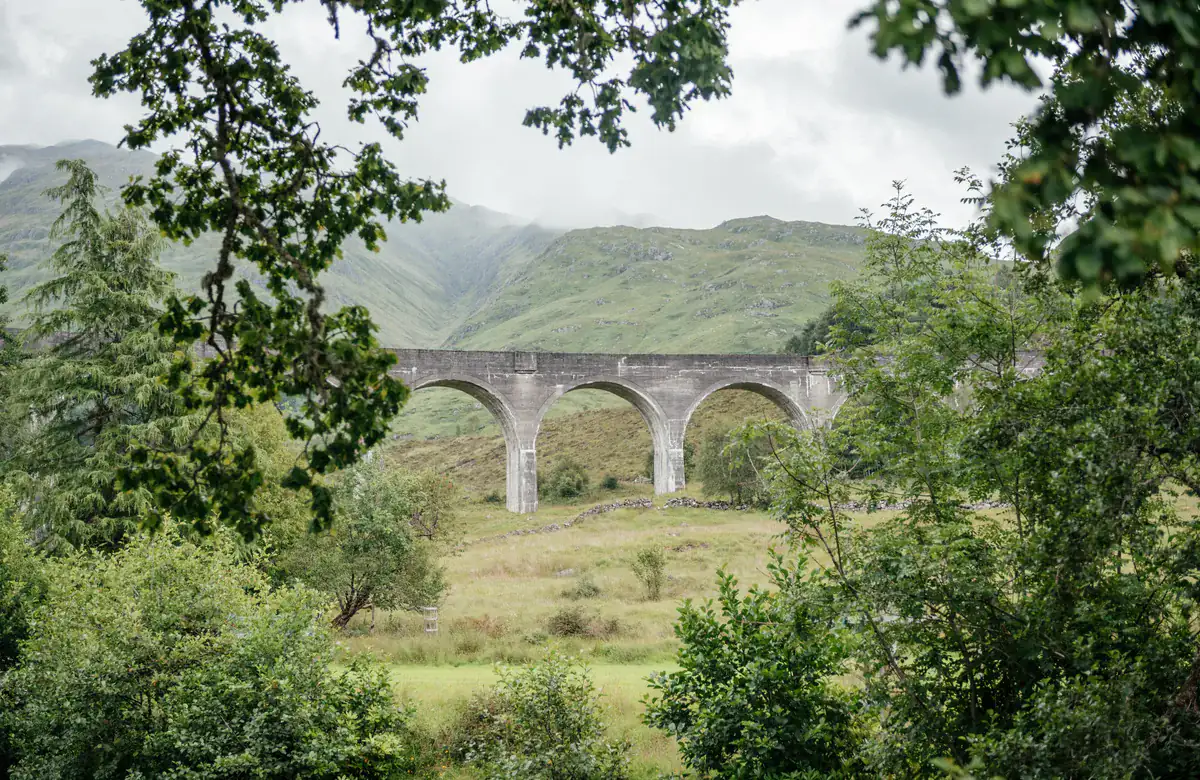
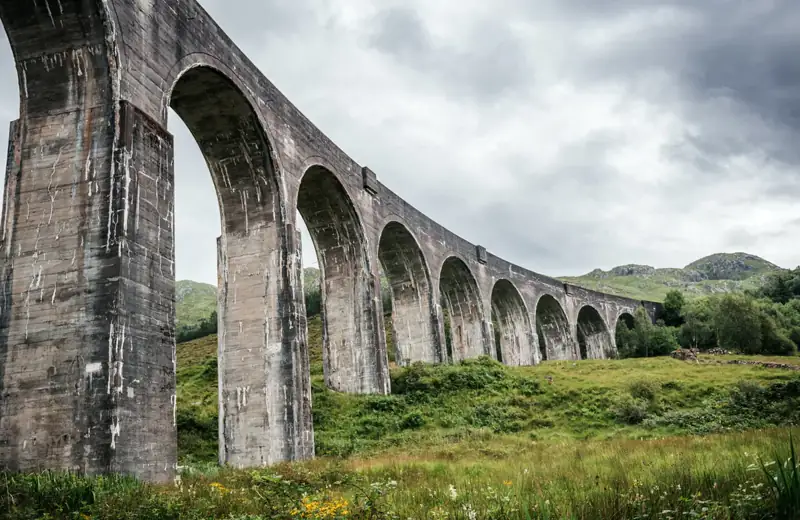
The Glenfinnan Viaduct carries the single-track West Highland Line over the River Finnan, near the head of Loch Shiel. It has 21 arches, each spanning 50 ft (15 m), stands 100 ft (30 m) high and runs 1,250 ft (380 m) long — the longest concrete railway viaduct in Scotland. It was built between 1897 and 1901 by Robert McAlpine & Sons, with Simpson & Wilson as engineers, and opened with the rest of the Mallaig Extension on 1 April 1901. It is a Category A listed structure (listed 4 October 1971) and is now owned by Network Rail.
Its designer, Sir Robert McAlpine, was nicknamed "Concrete Bob" for his pioneering large-scale use of mass (unreinforced) concrete — a material chosen here because the local schist rock was so hard to work. The graceful curve sits on a radius of about 12 chains (around 240–250 m), achieved by tapering the piers so the inner face is shorter than the outer; only two piers are hollow, designed as "stop" piers to prevent a chain-reaction collapse if an arch ever failed. The concrete work was notable enough to feature in American Engineering News in 1899, and the viaduct has even appeared on the Bank of Scotland £10 note.
There's also a famous legend: that during construction a horse and cart fell into one of the hollow piers and was entombed in the concrete. For decades it was treated as Glenfinnan folklore — but radar surveys later found a horse and cart not in the Glenfinnan Viaduct at all, but in the nearby Loch nan Uamh Viaduct further along the line. So the legend is real; it's just attached to the wrong bridge.