The flying Ford Anglia
The most famous scene — Harry and Ron, having missed the train, chase the Hogwarts Express over the viaduct in the flying car, swooping in and out of the arches.
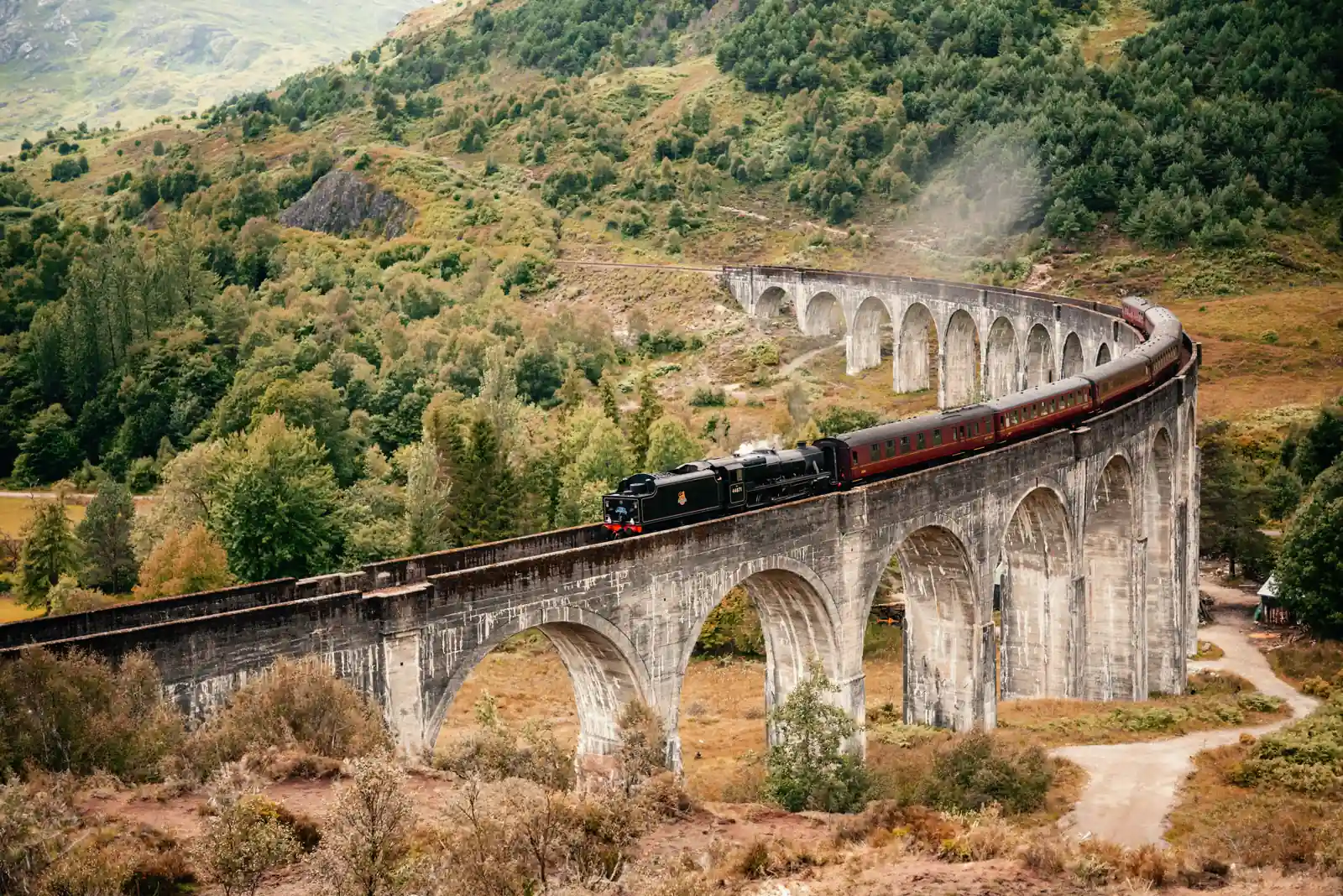
The "Harry Potter train" you're picturing is really the Jacobite Steam Train, operated by West Coast Railways from Fort William to Mallaig. It runs the actual route and crosses the real Glenfinnan Viaduct seen in the films — and West Coast Railways was the very company Warner Bros. approached to source a steam engine and carriages for filming. So when fans call the Jacobite "the real Hogwarts Express", they're essentially right.
The nuance the headlines miss: "Hogwarts Express" is a fictional name, and the specific locomotive filmed on screen, GWR 5972 "Olton Hall", is no longer on this line — it's a static exhibit at Warner Bros. Studio Tour London. The on-screen interiors and Platform 9¾ were filmed on sets at King's Cross and Leavesden Studios. So: same operator, same route, same bridge — different engine.
Live dates and prices for the featured Jacobite tour from Edinburgh.
The Glenfinnan Viaduct and the West Highland Line feature in four films, most heavily in the early ones.
The most famous scene — Harry and Ron, having missed the train, chase the Hogwarts Express over the viaduct in the flying car, swooping in and out of the arches.
The train is stopped near the viaduct by Dementors hunting Sirius Black; one boards and attacks Harry before Lupin repels it. Loch Eilt and Glen Coe also feature heavily.
The Hogwarts Express crosses the viaduct toward the castle — the last time the viaduct is shown in the series, with Loch Shiel and the digitally added castle behind.
The train passes through the Highland landscape, including views toward Loch Shiel and the Rannoch Moor area.
Other Scottish scenery appears in later films too — the Death Eaters stop the train on Rannoch Moor in Deathly Hallows Part 1 — and all eight films include some Scottish-shot footage.
Beyond the Jacobite — top-rated tours and tickets across Edinburgh, the Highlands, the Isle of Skye and Loch Ness that pair well with a Hogwarts Express day.
The engine that played the Hogwarts Express is GWR 4900 Class No. 5972 "Olton Hall", a Hall Class 4-6-0 built in April 1937 at Swindon Works. Withdrawn in 1963 and sent to the Barry scrapyard, it was rescued in 1981 by David Smith — founder of West Coast Railways — and restored at Carnforth.
For the films it was painted a non-standard crimson (GWR engines were traditionally green) and renamed "Hogwarts Castle" — a quirk, since it's actually a Hall, not a Castle Class, which has confused model-makers ever since. On screen it pulled four (later five) British Rail Mark 1 carriages.
Its mainline certificate expired in 2014, and in 2015 it was placed on static display at Warner Bros. Studio Tour London — The Making of Harry Potter in Leavesden, parked at a recreated Platform 9¾. It remains there in 2026, on long-term loan from West Coast Railways. The Jacobite today is typically hauled by an LMS "Black Five" such as No. 45407 The Lancashire Fusilier or No. 44871.
Searchers conflate several very different attractions. Only one is the genuine filming train on the genuine route.
The real train, real route, real Glenfinnan Viaduct: a genuine 84-mile round-trip steam journey, Fort William to Mallaig. This is the one that "is" the Hogwarts Express in spirit.
Home of the actual filming locomotive, Olton Hall, and the original carriages at a recreated Platform 9¾. You can board a carriage and photograph the engine — but it's static and doesn't move. This is where the real film train lives.
Opened 2023 in Nerima. Its Hogwarts Express is a real British steam engine — No. 4920 "Dumbleton Hall", a classmate of Olton Hall built 1929 and dressed as "Hogwarts Castle". Authentic period locomotive, but not used in the films.
At Universal Orlando the Hogwarts Express actually transports you between two parks (a park-to-park ticket is required); the trains are full-size replicas. Hollywood and Japan have static prop trains for photos only.
Not a train at all, but the real station with a free Platform 9¾ photo opportunity — a luggage trolley embedded in a wall — and the official Harry Potter Shop next door.
Built 1897–1901 of mass concrete by "Concrete Bob" McAlpine — the longest concrete railway bridge in Scotland, and even on the Bank of Scotland £10 note. Below it, Loch Shiel doubles as the "Black Lake".
To watch it cross free, park at the National Trust for Scotland visitor centre (£5 per car, free for members), walk the 10–20 minute uphill trail to the viewpoint, and arrive 45–60 minutes early on steam days. The morning Jacobite crosses around 10:45–11:00 — and because it runs out and back, you get two chances a day. Regular ScotRail trains cross year-round too.
Many of these sit right beside the line — you'll pass several from your seat.
The "Black Lake" beside the viaduct; setting for Triwizard Tournament scenes and the Durmstrang ship in Goblet of Fire.
The small island used for Dumbledore's grave in Deathly Hallows; Hagrid skims stones here in Prisoner of Azkaban. The Jacobite passes right alongside it.
Scotland's second-highest waterfall (120 m); the Glen Nevis landscape backed the Triwizard dragon chase in Goblet of Fire and many Quidditch scenes.
Site of Hagrid's Hut, built at Clachaig Gully for Prisoner of Azkaban. The set is gone, but the scenery remains.
Where the Death Eaters stop the train in Deathly Hallows Part 1.
Close-up "Black Lake" shots at Loch Morar; aerial and dragon-flight shots at Loch Arkaig, digitally blended with Loch Eilt for the grave scenes.
The easiest way to ride the genuine filming train without the 3.5-hour drive to Fort William or the scramble for sold-out direct tickets. This full-day tour pairs a Jacobite steam-train leg with a coach route through Glencoe and the Road to the Isles, a live guide on the Harry Potter connections, and free time in Mallaig.
Meeting point and departure time are confirmed at booking. An early start is required for the full Highland day.
See live dates and prices above, or check availability directly:
Check Availability & PricesFree cancellation up to 24 hours before the tour.
Book direct at westcoastrailways.co.uk — it sells out months ahead. Two 2026 caveats are worth knowing first.
An 84-mile round trip, about 2h 10m each way. The 2026 morning service runs 1 June–23 October; the afternoon service 10 June–25 September.
Adult day return: £76 Standard, £116 First Class; child £43 / £76; Private Table for 2 £252. A £3.75 minimum booking fee applies. Return only.
To run legally during the door-locking retrofit, the 2026 train uses Mark 2 carriages — so the vintage "HP" compartment carriage, the most film-like option, isn't available this season.
Regular ScotRail services run Fort William–Mallaig year-round (around £10 one way) — no steam, but the same scenery and the same viaduct crossing.
The questions searchers ask most about the "real Hogwarts Express", answered for 2026.
It's the real route and the real bridge from the films, run by the company that supplied the film train — but the exact filmed engine (Olton Hall) is now on static display at Warner Bros. Studio Tour London.
On screen it was GWR 5972 "Olton Hall." In real life on the route it's the Jacobite, now usually hauled by an LMS Black Five.
It runs from Fort William to Mallaig on the West Highland Line, crossing the Glenfinnan Viaduct.
Yes — ride the Jacobite (Fort William–Mallaig). You can also board the static film train at Warner Bros. Studio Tour London and ride the between-parks Hogwarts Express at Universal Orlando (a park-to-park ticket is required).
Jacobite 2026 fares: £76 standard adult return and £116 First Class adult return, plus a booking fee.
Mainly the West Highland Line and Glenfinnan Viaduct in the Scottish Highlands, plus King's Cross and Leavesden Studios for the interiors and Platform 9¾.
Chamber of Secrets, Prisoner of Azkaban, Goblet of Fire and Half-Blood Prince.
Olton Hall is on static display at Warner Bros. Studio Tour London, Leavesden, at a recreated Platform 9¾.
Yes — it's free, in the concourse at King's Cross Station, London, next to the Harry Potter Shop.
Park at the Glenfinnan visitor centre, walk to the viewpoint, and time it for the late-morning crossing (around 10:45–11:00).